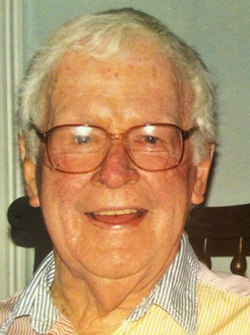
Edgar Driscoll, 91; art critic, obituary writer for Globe
[By Gloria Negri Globe Staff, November 9, 2011, ]
In an art review for the Globe in 1949, Edgar J. Driscoll Jr. described the ways creating a portrait can constrain an artist.
“He cannot paint exactly as he pleases,’’ Mr. Driscoll wrote. “He must subordinate some of his artistic impulses to adhere to the accepted rule. That is where the challenge comes in, to be true to his own painting inclinations and integrity, yet ‘satisfy the customer.’ The nonmaterial reward comes when he manages to do both.’’
He might have been describing the experience he would have over the next few decades practicing a kind of verbal portraiture as an art critic and obituary writer for the Globe.
Mr. Driscoll, who was on the Globe staff for 44 years, died Nov. 1 of congestive heart failure in his Beacon Hill home. He was 91.
With the sharp vision of a writer who appraised artists’ work, Mr. Driscoll captured his subjects’ essence. When Ray Bolger, the scarecrow in “The Wizard of Oz,’’ died in 1987, Mr. Driscoll wrote in his obituary of the Dorchester-born entertainer: “Tall, narrow-hipped, and loose-jointed, Mr. Bolger had a stage presence that was filled with grace and energy as he belted out lyrics and performed a flurry of leaps, kicks, spins, and grimaces — even a bump-and-grind shtick — to the roar of the crowd.’’
Mr. Driscoll also had an ear for a lively anecdote. In a 1991 obituary about Charles Whipple, a former editorial page editor at the Globe and the newspaper’s first ombudsman, Mr. Driscoll wrote about the time Whipple tried to interview Red Sox star Ted Williams, who was known for disliking reporters:
“Characteristically, Williams refused to talk to Mr. Whipple. ‘Mr. Williams,’ the reporter said, ‘I’d give my right eye for an interview.’ Mr. Whipple plucked out from his right socket the glass eye he wore as a result of an injury, and offered it to Williams. The Red Sox slugger roared with laughter and spent the next hour chatting with his visitor.’’
In Boston art circles and in the Beacon Hill neighborhood where he lived for decades, Mr. Driscoll was known for his kindness and the attention he paid friends and strangers alike.
“If you were in the hospital for two days, there was Eddie with flowers,’’ said Henry Lee, a longtime Beacon Hill friend. “He was enormously charming and sociable. If he took a train trip, he would know everyone on the train when it was over.’’
Mr. Driscoll’s warmth also nurtured children who were assisted by the Cambridge Art Association, where he had been on the board of directors.
“Edgar’s devotion to children lifted the spirits of many special needs students in the Cambridge Art Association’s ‘The Art of Love’ annual exhibit,’’ said Kathryn Schultz, the director.
She said Mr. Driscoll “believed there was something positive in almost everything he looked at, if not in execution, in effort. He said, ‘I can’t do nasty.’ ’’
That was a reference to Mr. Driscoll’s reluctance to destroy a new artist’s career in his criticism. “Edgar embraced the mission of the association, to nurture and support emerging artists,’’ Schultz said. “He encouraged hundreds of local artists.’’
Optimism and gratitude “steered him through life,’’ said his daughter Elizabeth Conklin of Chester Springs, Pa. “He always saw the good in others, embracing people and life with a youthful exuberance and open mind. Dad’s joie de vivre was infectious. His signature adage was: ‘Look up, not down. Look out, not in.’ ’’
Mr. Driscoll’s other daughter, Abigail Lee of Potsdam, N.Y., said he “was great in seeing the beauty and hope in things.’’
“His eye for details, coupled with a wonderful memory of people and places, was endless.’’
Born in Boston, Mr. Driscoll was one of seven children of Katharine (Rooney) and Edgar J. Driscoll Sr. and grew up in West Roxbury.
He graduated from the Cambridge School of Weston, a preparatory school where teachers recommended he attend the University of Iowa so he could study with Grant Wood, the artist best known for the painting “American Gothic.’’
Mr. Driscoll went to Iowa, then transferred to Yale University’s School of Fine Arts, from which he graduated in 1943.
He served in the US Army Air Corps, his family said, but was honorably discharged because of a skin condition.
Mr. Driscoll began his newspaper career as a copy boy with the Boston Herald and later was hired as a reporter, sometimes illustrating the stories he covered.
In 1945, he joined the Globe as a general assignment reporter working nights and became its art critic in 1947.
Mr. Driscoll’s assignments went beyond art criticism. He reviewed movies and interviewed celebrities, including the actresses Katharine Hepburn and Bette Davis and artist Andrew Wyeth.
While working at the Globe, he met Elizabeth Ware Watts, a general assignment reporter and feature writer, and they married in 1955.
When she died last year, Mr. Driscoll said in an interview for her obituary that he was enchanted “not only by her beauty, but by her wit, charm, and intelligence.’’
“Liz was a very warm and giving person,’’ he said.
Mr. Driscoll began writing obituaries in the 1970s. His writing was so evocative that a woman once told a friend of the Driscolls that she attended a funeral of someone she had not known because the obituary Mr. Driscoll wrote was so interesting.
Though beset with many health challenges over the years, Mr. Driscoll tried to keep fit by walking from the Globe on Morrissey Boulevard to his Beacon Hill home, Abigail said.
One thing that kept Mr. Driscoll going, Henry Lee said, “was his Catholic faith.’’
“He was still a good Catholic,’’ Lee said. “He never talked about it. He just did it.’’
A service was held Monday for Mr. Driscoll, who in addition to his two daughters leaves his son, Edgar III of Boston; a brother, William of Jaffrey, N.H.; and four grandchildren.
Although his brother wrote many obituaries, “Eddie would never have thought of writing his own,’’ William Driscoll said. “He had no idea how revered he was.’’